SEO Title: Section 9 Trademark Objection Under the Trade Marks Act, 1999: Grounds, Examples & How to Respond
Meta Description: Understand Section 9 trademark objections in India, including lack of distinctiveness, descriptive marks, deceptive marks, functional shapes, acquired distinctiveness and evidence required to overcome an objection.
Focus Keyword: Section 9 trademark objection
Secondary Keywords: trademark objection under Section 9, Section 9 Trade Marks Act, trademark distinctiveness, descriptive trademark, acquired distinctiveness, trademark objection reply, trademark registration India
Introduction
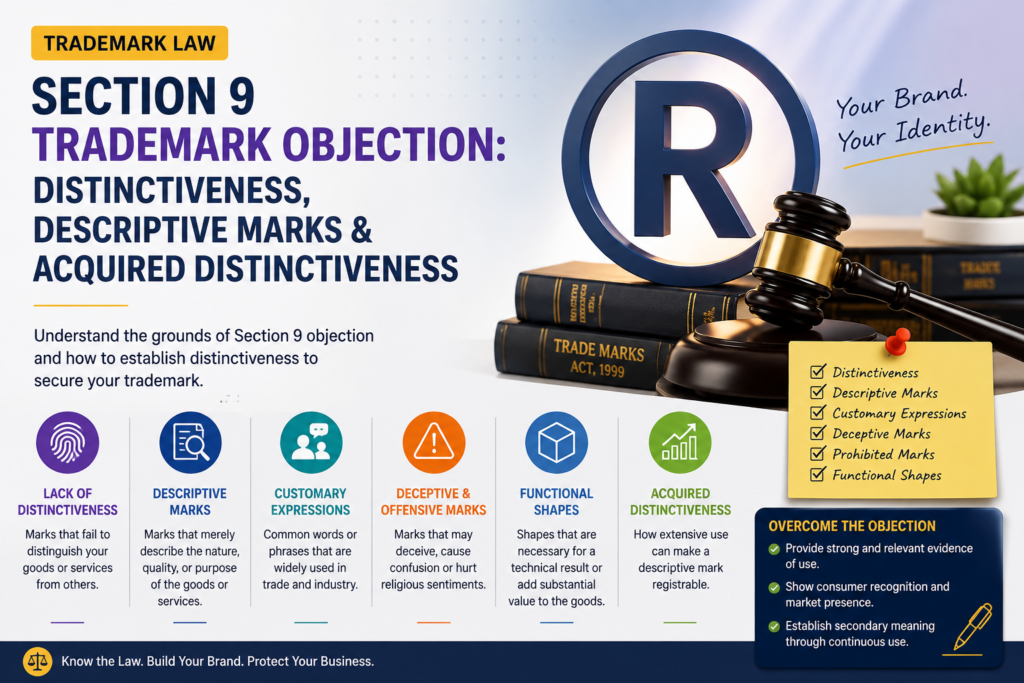
A Section 9 trademark objection is one of the most common objections raised during the trademark registration process in India. It generally arises when the Trade Marks Registry considers that a proposed trademark is not sufficiently distinctive, is descriptive of the goods or services, is deceptive, or falls within another absolute ground for refusal.
Under Section 9 of the Trade Marks Act, 1999, a trademark must be capable of distinguishing the goods or services of one business from those of another. In simple terms, a trademark should function as a badge of commercial origin, rather than merely describe the product or service.
Understanding the grounds of a Section 9 objection and knowing how to establish distinctiveness can significantly improve the chances of successfully responding to the objection.
What Is a Section 9 Trademark Objection?
Section 9 deals with the absolute grounds for refusal of trademark registration. These grounds focus on the inherent nature and characteristics of the trademark itself.
Unlike objections based on an earlier conflicting trademark, a Section 9 objection may arise even when there is no prior registered or pending trademark that conflicts with the applicant’s mark.
The Registry may raise an objection where a trademark:
- Lacks distinctive character;
- Merely describes the goods or services;
- Has become customary in the trade;
- Is deceptive or likely to confuse consumers;
- Contains prohibited, scandalous or offensive matter;
- May hurt religious susceptibilities; or
- Consists exclusively of certain functional or value-enhancing product shapes.
1. Trademark Lacking Distinctive Character – Section 9(1)(a)
Section 9(1)(a) applies when a trademark is incapable of distinguishing the goods or services of one person from those of another.
For example, expressions such as:
- BEST QUALITY
- PREMIUM SERVICE
- SUPER FAST
may be considered ordinary promotional or laudatory expressions rather than trademarks identifying a particular business.
1.1 What Makes a Trademark Distinctive?
Distinctiveness exists on a spectrum.
Invented or coined words are generally considered stronger trademarks because they have no ordinary dictionary meaning in relation to the goods or services. For example, a coined term such as “ZENVORA” may have strong inherent distinctiveness.
Arbitrary marks can also be distinctive. An ordinary dictionary word may function as a strong trademark when used for unrelated goods. For example, “ANCHOR” could be distinctive for stationery even though the word has an existing meaning.
The key question is whether consumers are likely to perceive the mark as identifying a particular commercial source.
2. Descriptive Trademarks – Section 9(1)(b)
Section 9(1)(b) prevents registration of trademarks that exclusively describe characteristics of the goods or services.
This may include the:
- Kind or nature of the goods;
- Quality;
- Quantity;
- Intended purpose;
- Value;
- Geographical origin; or
- Other characteristics of the goods or services.
Examples include:
- CREAMY for dairy products;
- QUICK DELIVERY for courier services;
- JAIPUR TEXTILES for textiles originating from Jaipur; and
- SUGAR FREE for products without sugar.
2.1 Why Are Descriptive Trademarks Difficult to Register?
Trademark law generally seeks to prevent one trader from monopolising words that competitors legitimately need to use to describe their products or services.
For example, if one business could obtain exclusive trademark rights over an ordinary descriptive expression, competitors might be restricted from using common commercial language.
This is one of the principal reasons why descriptive trademarks frequently receive Section 9 objections.
3. Common or Customary Expressions – Section 9(1)(c)
Section 9(1)(c) addresses words or expressions that have become customary in the current language or in established and bona fide trade practices.
Such expressions generally do not identify one particular commercial source because they are commonly used by businesses or consumers in relation to the relevant goods or services.
Therefore, merely using a common industry expression as a brand may not be sufficient to establish trademark distinctiveness.
4. Deceptive, Offensive and Prohibited Marks – Section 9(2)
Section 9(2) contains additional absolute grounds for refusal.
A trademark may be refused if its use is likely to:
- Deceive or confuse the public;
- Misrepresent the nature, quality, composition or geographical origin of goods or services;
- Contain scandalous or obscene matter;
- Hurt the religious susceptibilities of a class or section of Indian citizens; or
- Contain matter whose use is prohibited under applicable law, including the Emblems and Names (Prevention of Improper Use) Act, 1950.
4.1 Example of a Deceptive Trademark
Consider a mark such as “PURE SILK” used for fabric that is entirely synthetic.
Such a mark may mislead consumers regarding the composition or nature of the product and could therefore face an objection under Section 9(2).
5. Functional Product Shapes – Section 9(3)
Section 9(3) prevents trademark registration where the mark consists exclusively of certain types of shapes.
These include a shape:
- Resulting from the nature of the goods;
- Necessary to obtain a technical result; or
- Giving substantial value to the goods.
The underlying principle is that trademark law should not provide indefinite monopoly rights over product features that competitors need to manufacture functional or effective products.
For example, the ordinary shape of a key designed to fit a particular lock may primarily perform a technical function rather than identify the commercial source of the product.
6. Acquired Distinctiveness: How Can a Descriptive Trademark Be Protected?
Not every descriptive or initially non-distinctive trademark is permanently incapable of registration.
The proviso to Section 9(1) recognises situations where a mark has acquired distinctive character through use before the relevant application date or has become a well-known trademark.
This concept is commonly referred to as acquired distinctiveness or secondary meaning.
6.1 What Is Acquired Distinctiveness?
A trademark may begin as an ordinary descriptive expression. However, extensive and consistent commercial use may cause consumers to associate that expression specifically with one business.
In such circumstances, the mark may acquire a distinctive character in the marketplace.
The Supreme Court has recognised that descriptive expressions can receive trademark protection where they have acquired a secondary meaning and become associated with a particular commercial source.
7. What Evidence Can Help Overcome a Section 9 Objection?
Simply claiming that a trademark is “famous,” “well known,” or “widely used” is generally not sufficient.
The applicant should provide credible evidence demonstrating that consumers had come to identify the mark with the applicant’s goods or services, particularly before the relevant trademark application date where acquired distinctiveness is being claimed.
Useful evidence may include:
- Invoices showing continuous sales;
- Sales and turnover figures;
- Advertising and promotional material;
- Advertising expenditure;
- Product packaging and labels;
- Website records;
- Social-media campaigns;
- Media coverage;
- Market surveys;
- Distribution records;
- Earlier trademark enforcement actions; and
- Evidence of recognition of the mark in the relevant market.
7.1 Evidence Must Be Relevant to the Trademark
The evidence should specifically relate to the trademark that is the subject of the objection and the relevant goods or services.
For example, substantial turnover generated by completely different brands owned by the same company may not establish that the disputed trademark has acquired distinctiveness.
The quality, chronology and relevance of evidence can therefore be critical when preparing a reply to a Section 9 objection.
8. Consider the Trademark as a Whole
A trademark should not always be examined by looking at individual words in isolation.
A composite trademark may contain descriptive or non-distinctive elements but nevertheless possess sufficient distinctiveness because of its overall presentation, arrangement, logo, stylisation or additional distinctive elements.
However, applicants should understand the scope of protection.
Under Section 17 of the Trade Marks Act, 1999, registration generally protects the trademark as a whole. Registration of a composite mark does not necessarily give the proprietor exclusive rights over every descriptive or common element contained within that mark.
Therefore, an applicant should distinguish between:
Protection of the overall trademark and exclusive rights over individual descriptive/common words.
How to Respond to a Section 9 Trademark Objection
A strong Section 9 objection reply should address the specific ground raised by the Trademark Registry rather than relying on generic statements.
Depending on the facts, the response may establish that:
- The mark is inherently distinctive;
- The mark is a coined or arbitrary expression;
- The mark does not exclusively describe the relevant goods or services;
- The trademark should be assessed as a whole;
- The mark has acquired distinctiveness through extensive use;
- The applicant has substantial commercial presence under the mark; or
- Supporting documentary evidence demonstrates consumer recognition.
Where acquired distinctiveness is relied upon, the applicant should carefully establish when use began, how extensively the mark has been used and how consumers associate the mark with the applicant.
Section 9 vs. Other Trademark Objections
It is important to distinguish a Section 9 objection from other types of trademark objections.
Section 9: Focuses primarily on the inherent characteristics and registrability of the mark.
Section 11: Generally concerns conflicts with earlier trademarks and likelihood of confusion.
Therefore, a Section 9 objection can arise even when there is no earlier trademark that is identical or similar to the applicant’s mark.
Conclusion
A Section 9 trademark objection essentially asks whether the proposed trademark is capable of functioning as an identifier of commercial origin.
Descriptive, customary, deceptive and certain functional marks may face difficulty because trademark law must preserve fair competition and prevent businesses from obtaining unnecessary monopolies over ordinary language or functional product features.
However, a Section 9 objection is not necessarily the end of the trademark registration process.
A mark may overcome the objection where it is distinctive when considered as a whole or where it has acquired secondary meaning through substantial and relevant use.
For this reason, a well-prepared trademark objection reply should combine legal arguments with documentary evidence. The applicant should focus on the exact objection raised, the nature of the mark, the relevant goods or services and the history of use.